Publications

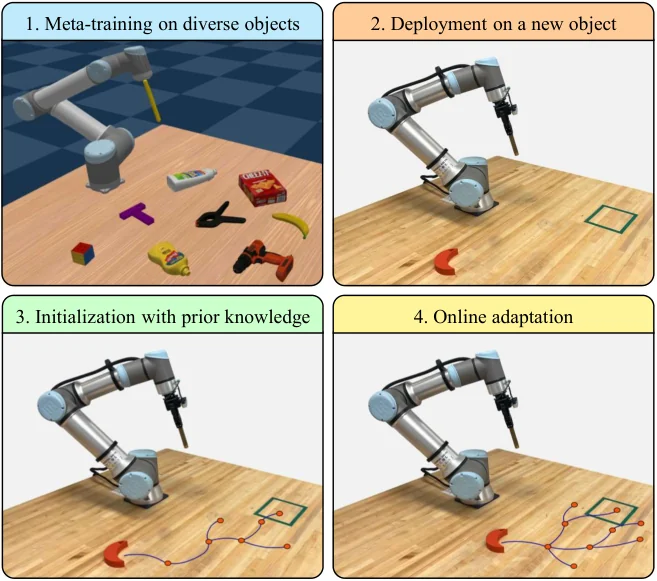
MetaPusher method overview showing meta-training, deployment on a new object, prior knowledge, and online adaptation
arXiv preprint · 2026Preprint

MetaPusher: Meta Learning and Planning for Nonprehensile Manipulation of Unseen Objects with Rapid Online Adaption

Donghyung Lee*, Seyedali Golestaneh*, Jaskrit Singh, Zhuoyun Zhong, Athanasios Kapoutsis, Constantinos Chamzas* Equal contribution

Manipulating previously unseen objects remains challenging, as their dynamics depend on latent physical properties, such as friction and mass distribution, that cannot be inferred from perception alone. Prior experience across objects can provide an initial estimate of unseen object dynamics, but this estimate remains uncertain and can degrade further during sim-to-real transfer. Adapting the dynamics through interaction can progressively refine the estimation, however, updating the model may invalidate the planned trajectory. Successful and efficient manipulation therefore requires both rapid dynamics adaptation and a planning strategy that can incorporate this evolution. In this work, we introduce MetaPusher, a meta-learning and adaptive planning framework for nonprehensile manipulation of unseen objects without prior object-specific interactions. A meta-learned dynamics model rapidly adapts from interactions during task execution, while an adaptive kinodynamic planner updates long-horizon plans by reusing and refining its existing search tree. This coupling enables manipulation and adaptation without a separate data collection phase. We evaluate MetaPusher on unseen objects in simulation and in sim-to-real scenarios, comparing against fine-tuning and active learning methods, MPPI-based control, and a reinforcement learning policy. It achieves lower prediction error and improves task success rate by up to 20%.

arXiv
BibTeX
@article{lee2026metapusher,
  title={MetaPusher: Meta Learning and Planning for Nonprehensile Manipulation of Unseen Objects with Rapid Online Adaption},
  author={Lee, Donghyung and Golestaneh, Seyedali and Singh, Jaskrit and Zhong, Zhuoyun and Kapoutsis, Athanasios and Chamzas, Constantinos},
  journal={arXiv preprint arXiv:2609.21122},
  year={2026}
}
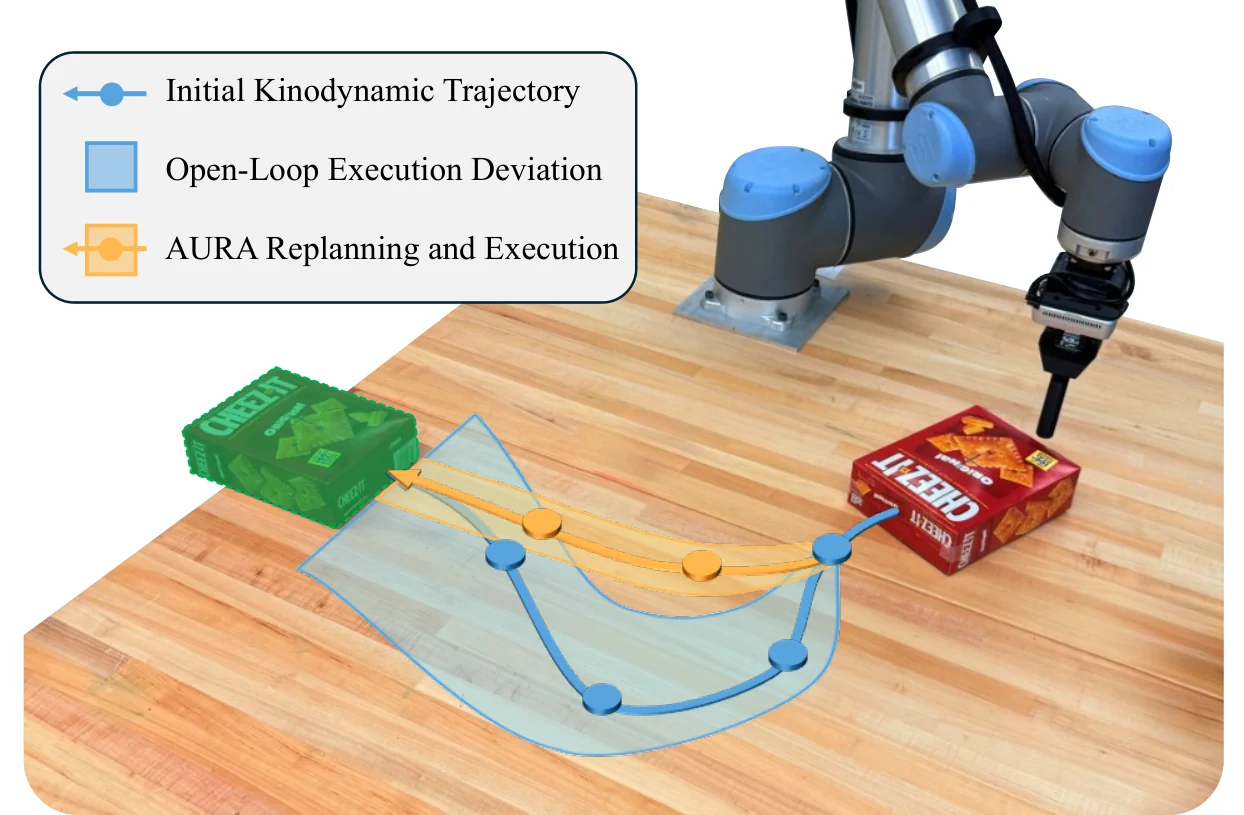
AURA illustration of a robot pushing an object, an execution deviation, and replanned paths
IEEE Robotics and Automation Letters · 2026Accepted · Sep 2026

AURA: Asymptotically Optimal Uncertainty-Robust Replanning Algorithm for Kinodynamic Systems

Seyedali Golestaneh, Zhuoyun Zhong, Donghyung Lee, Constantinos Chamzas

Sampling-based motion planners offer a practical and scalable approach to kinodynamic motion planning, notably for high-dimensional, underactuated, or non-holonomic systems. However, these planners are typically used offline, requiring execution to begin only after the trajectory has been computed. In addition, the planned trajectory may not be accurately tracked in the presence of motion uncertainty, leading to deviations from the nominal solution. In this work, these limitations were addressed within a unified framework, AURA, an asymptotically-optimal meta-planner framework that improves both path quality and tracking performance during execution. In addition to the main execution thread, this framework comprises a replanning method that continuously explores the state space and refines the trajectory during execution, and an optimization process that refines future control inputs to reduce tracking error. Together, these components enable AURA to leverage asymptotically optimal planning online while improving execution accuracy under motion uncertainty. The proposed approach is evaluated in both simulation and real-world environments across multiple systems, demonstrating consistent improvements in trajectory quality, tracking accuracy, and overall performance compared with baselines.

PaperIEEEarXivCode
BibTeX
@article{golestaneh2026aura,
  title={AURA: Asymptotically Optimal Uncertainty-Robust Replanning Algorithm for Kinodynamic Systems},
  author={Golestaneh, Seyedali and Zhong, Zhuoyun and Lee, Donghyung and Chamzas, Constantinos},
  journal={IEEE Robotics and Automation Letters},
  year={2026}
}
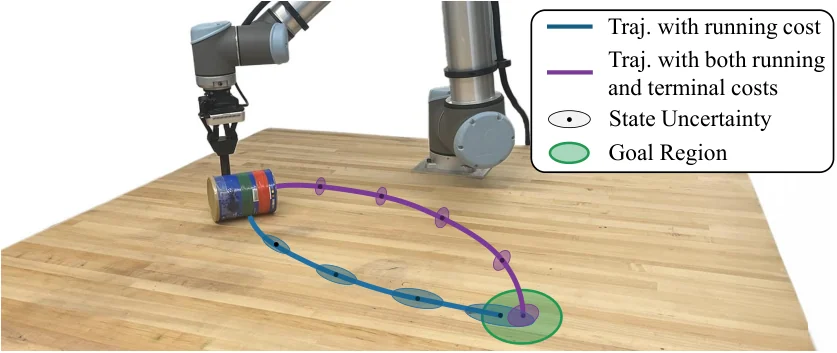
Terminal Matters (KiTe) examples of planar pushing and car parking
arXiv preprint · 2026Preprint · KiTe

Terminal Matters: Kinodynamic Planning with a Terminal Cost and Learned Uncertainty in Belief State-Cost Space

Zhuoyun Zhong, Seyedali Golestaneh, Constantinos Chamzas

In many real-world robotic tasks, robots must generate dynamically feasible motions that reliably reach desired goals even under uncertainty. Yet existing sampling-based kinodynamic planners typically optimize accumulated trajectory costs and treat goal reaching as a feasibility check, rather than explicitly optimizing terminal-state quality, such as goal preference or goal-reaching reliability. In this work, we introduce a terminal-cost formulation for kinodynamic planning that allows terminal-state quality to be optimized alongside accumulated trajectory cost. We prove that AO-RRT, an asymptotically optimal kinodynamic planner, preserves its asymptotic optimality under this augmented objective. We further extend the formulation to belief space and prove that minimizing the Wasserstein distance between the terminal belief and the goal improves a lower bound on the probability of reaching the goal region. The resulting planner, KiTe, uses this terminal-cost objective to encode goal preferences and improve reliability under uncertainty. To support systems without analytical uncertainty models, we learn dynamics and process uncertainty directly from data and integrate the learned belief dynamics into planning. Experiments on Flappy Bird, Car Parking, and Planar Pushing show that KiTe consistently improves goal-reaching success under uncertainty. Real-world Planar Pushing experiments further demonstrate that KiTe can plan effectively with learned dynamics and uncertainty. Source code is available at https://github.com/elpis-lab/KiTe.

arXivCode
BibTeX
@article{zhong2026terminal,
  title={Terminal Matters: Kinodynamic Planning with a Terminal Cost and Learned Uncertainty in Belief State-Cost Space},
  author={Zhong, Zhuoyun and Golestaneh, Seyedali and Chamzas, Constantinos},
  journal={arXiv preprint arXiv:2605.09046},
  year={2026}
}
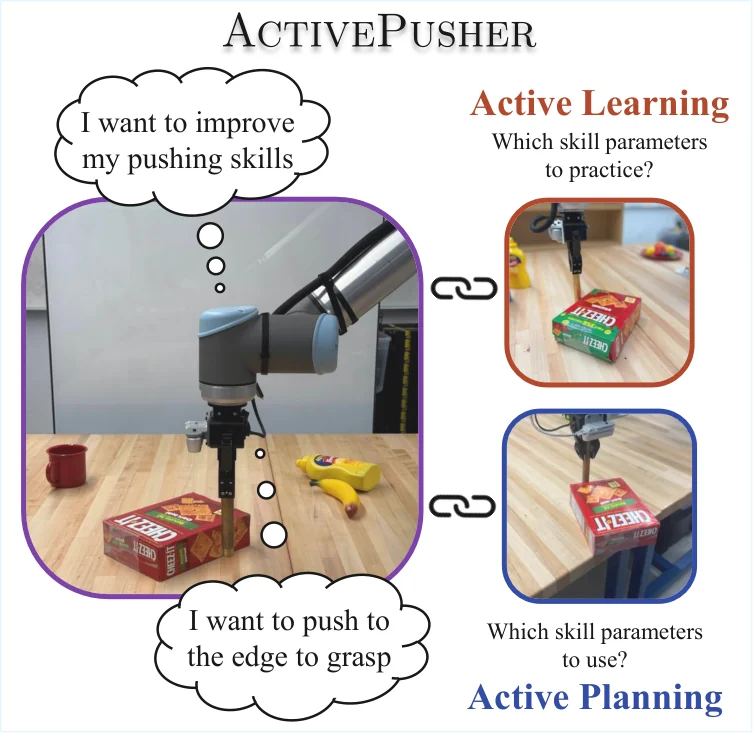
ActivePusher overview of active learning and planning for nonprehensile manipulation
IEEE International Conference on Robotics and Automation (ICRA) · 2026ICRA 2026 Best Student Paper AwardHRF 2026 Best Student Paper Award

ActivePusher: Active Learning and Planning with Residual Physics for Nonprehensile Manipulation

Zhuoyun Zhong, Seyedali Golestaneh, Constantinos Chamzas

Planning with learned dynamics models offers a promising approach toward versatile real-world manipulation, particularly in nonprehensile settings such as pushing or rolling, where accurate analytical models are difficult to obtain. However, collecting training data for learning-based methods can be costly and inefficient, as it often relies on randomly sampled interactions that are not necessarily the most informative. Furthermore, learned models tend to exhibit high uncertainty in underexplored regions of the skill space, undermining the reliability of long-horizon planning. To address these challenges, we propose ActivePusher, a novel framework that combines residual-physics modeling with uncertainty-based active learning, to focus data acquisition on the most informative skill parameters. Additionally, ActivePusher seamlessly integrates with model-based kinodynamic planners, leveraging uncertainty estimates to bias control sampling toward more reliable actions. We evaluate our approach in both simulation and real-world environments, and demonstrate that it consistently improves data efficiency and achieves higher planning success rates in comparison to baseline methods. The source code is available at https://github.com/elpis-lab/ActivePusher.

IEEEarXivCodeVideo
BibTeX
@inproceedings{zhong2026activepusher,
  title={ActivePusher: Active Learning and Planning with Residual Physics for Nonprehensile Manipulation},
  author={Zhong, Zhuoyun and Golestaneh, Seyedali and Chamzas, Constantinos},
  booktitle={2026 IEEE International Conference on Robotics and Automation (ICRA)},
  year={2026}
}
IEEE Access, vol. 13, pp. 49018–49029 · 2025Journal article

Robust and Efficient Phase Estimation in Legged Robots via Signal Imaging and Deep Neural Networks

Kamyab Yazdipaz, Nooshin Kohli, Seyed Ali Golestaneh, Mohammad Shahbazi

Accurate phase estimation in legged robots, determining whether legs are swinging or in ground contact, is crucial for stability and performance, especially on uneven terrain and with dynamic obstacles. This paper presents a novel approach to phase estimation using signal imaging and lightweight deep neural networks. Time-series data from an inertial measurement unit (IMU) and joint encoders are fused into phase images in real-time using Stacked Channels Image (SCI) and Recurrence Plot (RP) encoding methods. These phase images are then processed for phase classification, eliminating the need for force measurement sensors, which are prone to noise and failure. Extensive experiments on a 3-DoF hopping robot leg, with contact sensor data as ground truth, show that EfficientNet-B0 deep model achieves 98.97% accuracy with RP imaging and an optimized inference time of 2 milliseconds. Comparative validation on an independent dataset from the MIT Mini Cheetah traversing eight terrains demonstrates our model’s generalizability. The EfficientNet-RP-Mode1 configuration achieves 96.51% accuracy, outperforming traditional model-based methods and matching or surpassing other deep learning-based approaches, despite requiring fewer sensor inputs. This research highlights the efficiency, robustness, and adaptability of the proposed method, offering a reliable solution for phase estimation in diverse robotic platforms and environments.

DOI
BibTeX
@article{yazdipaz2025phase,
  title={Robust and Efficient Phase Estimation in Legged Robots via Signal Imaging and Deep Neural Networks},
  author={Yazdipaz, Kamyab and Kohli, Nooshin and Golestaneh, Seyed Ali and Shahbazi, Mohammad},
  journal={IEEE Access},
  volume={13},
  pages={49018--49029},
  year={2025},
  doi={10.1109/ACCESS.2025.3549165}
}